VA Loan Eligibility Requirements: Complete Service & Qualification Guide
 Understanding VA loan eligibility requirements is the first step toward homeownership. The VA loan program helps military members and veterans purchase homes with no down payment, competitive interest rates, and favorable terms. To qualify, you must meet specific service requirements and obtain a Certificate of Eligibility. This comprehensive guide covers every eligibility pathway - whether you're active duty, a veteran, Guard/Reserve member, or a surviving spouse.
What is a VA Loan Program?
The Department of Veterans Affairs created the VA loan program to help military members achieve homeownership. This loan benefit provides veterans, active-duty service members, and eligible spouses with access to home financing on favorable terms. The VA backs these loans, reducing risk for lenders and creating better conditions for borrowers seeking a VA mortgage.
VA loans offer several advantages over conventional home loans, including lower interest rates and no down payment. Borrowers can purchase a home without a down payment in most cases. The program also eliminates private mortgage insurance requirements, saving money each month. Veterans can refinance existing loans through VA programs and may qualify for special adapted housing grants, which can help them buy a home.
Am I Eligible for a VA Loan? Quick Eligibility Check
Your VA loan eligibility depends primarily on your military service record. The VA has established clear service-length thresholds for different groups. Active-duty service members, veterans, National Guard members, Reserve members, and surviving spouses all have distinct pathways to qualification. The key is proving you meet one of these service requirements and obtaining a Certificate of Eligibility (COE).
Basic Service Requirements for VA Loan Eligibility
Active Duty Military Members
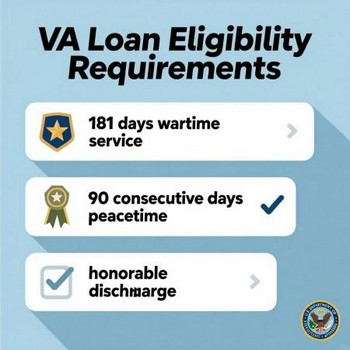
Current military personnel become eligible for a VA loan after serving 90 consecutive days of wartime service or 181 days of peacetime service. Each branch of the military has members who can apply for this loan benefit. The Army, Navy, Air Force, Marine Corps, Coast Guard, and Space Force all participate in the program.
Active duty members can apply for a VA loan while still serving. They do not need to wait until retirement or separation to access this benefit. Military personnel can use the loan multiple times throughout their service and after separation.
Veterans and Former Service Members
Veterans who received an honorable discharge qualify for VA loan benefits. The length of service determines eligibility. Veterans who served during wartime require at least 90 days of active duty service. Those who served during peacetime require 181 days of continuous active duty service.
Some veterans with shorter service periods may still qualify. Those discharged for a service-connected disability may be eligible for a VA mortgage, regardless of their service length. Veterans with hardship discharges may also be eligible under certain conditions.
National Guard and Reserve Members
National Guard and Reserve members have specific eligibility requirements. They must complete six years of service to qualify for a VA loan. Members who served on active duty for at least 90 days during a period of war also meet the requirements. Reserve and National Guard personnel called to active duty under federal orders may qualify with shorter service periods.
The VA recognizes service in the Army National Guard, Air National Guard, Army Reserve, Navy Reserve, Marine Corps Reserve, Air Force Reserve, and Coast Guard Reserve. Each component has members eligible for loan benefits after meeting service requirements.
Surviving Spouses
Surviving spouses of veterans may qualify for VA loan benefits under specific circumstances. The veteran spouse must have died in service or from a service-connected disability. Some surviving spouses who remarried after age 57 can retain eligibility for a VA home loan. Spouses of prisoners of war or those missing in action may also qualify.
The VA reviews each case individually to determine eligibility as a surviving spouse. Required documentation includes death certificates and proof of the veteran's service record.
Certificate of Eligibility (COE): Your Proof of Qualification
What is a Certificate of Eligibility?
The Certificate of Eligibility (COE) is an official document that proves your qualification for a VA loan. Veterans and service members must obtain this certificate before applying for financing. The VA issues the COE after verifying military service and discharge status. Your COE demonstrates to lenders that you meet VA loan eligibility requirements.
How to Get Your COE
Applicants can request a COE through several methods. The eBenefits portal allows online applications, resulting in faster processing - often within days for complete submissions. Veterans can also apply by mail using VA Form 26-1880. Lenders often help borrowers obtain the COE during the loan application process, so you don't have to handle it alone.
Required Documentation for COE
The COE application requires specific military documents. Veterans need their DD-214 discharge papers, which show their service dates and discharge type. Active duty members provide a statement of service from their commanding officer.
National Guard and Reserve members need additional documentation. They must provide their latest annual retirement points statement and evidence of honorable service. The VA may request additional records to verify eligibility.
COE Processing Time
Standard COE applications typically process within 2-3 weeks. Online applications through eBenefits often receive faster processing - veterans with complete documentation experience shorter wait times, sometimes just days. Some applications require additional review and take longer to process. Complex cases involving disability discharges or surviving-spouse claims may require additional time. The VA contacts applicants if they need further information.
Financial and Credit Requirements
Minimum Credit Score Considerations
VA loans do not have a government-mandated minimum credit score. However, most lenders require credit scores of 580 or higher. Some lenders may accept lower scores with additional documentation or larger down payments. Check VA loan credit score requirements for detailed guidance on improving your profile.
Veterans with credit challenges have options. They can work with VA-approved lenders who specialize in helping borrowers with lower credit scores. Credit counseling and debt consolidation may help improve scores before applying.
Income and Employment Verification
Borrowers must demonstrate stable income to qualify for a VA loan. Lenders verify employment history and current income through pay stubs, tax returns, and employment letters. Military members can utilize their base pay, allowances, and other forms of military income.
The VA does not set specific income requirements. Instead, lenders evaluate debt-to-income ratios to determine affordability. Most lenders prefer ratios below 41%, though exceptions exist for well-qualified borrowers. Use our Debt-to-Income Ratio Calculator to estimate your qualification threshold.
VA Funding Fee
Most VA loan borrowers pay a funding fee to support the program. The cost varies based on loan type, down payment amount, and veteran status. First-time users typically pay 2.15% of the loan amount. Veterans using the benefit again pay 3.3%.
Some veterans are exempt from the funding fee. Those receiving VA disability compensation do not pay this fee. Surviving spouses also receive funding fee exemptions in most cases when applying for a VA home loan. Use our VA funding fee calculator to estimate your exact costs.
Property Requirements and Restrictions
Primary Residence Requirement
VA loans can only finance primary residences. Borrowers must occupy the home within 60 days of closing. The property cannot be used solely as an investment or vacation home.
Veterans can purchase various property types with VA loans. Single-family homes, condominiums, and manufactured homes are all eligible. Multi-unit properties up to four units are allowed if the borrower lives in one unit.
Property Condition Standards
VA loans require properties to meet minimum condition standards. The home must be safe, structurally sound, and sanitary. VA appraisers inspect properties to verify they meet these requirements.
Properties with significant defects may not qualify. Issues like faulty electrical systems, plumbing problems, or structural damage must be repaired before loan approval. The VA protects borrowers by ensuring properties are suitable for occupancy. Environmental concerns including lead-based paint, mold, and well water quality may also be evaluated.
Types of VA Loans Available
Purchase Loans
VA purchase loans help veterans buy homes with favorable terms. These loans offer 100% financing for qualified borrowers. Veterans can purchase homes without down payments in most cases.
The loan amount for a VA mortgage depends on the VA loan limit in the area. Veterans with full entitlement can borrow up to the conforming loan limit without down payments. Those with reduced entitlement may need a larger down payment for higher-priced homes. Check 2026 VA loan limits by county for your area.
Refinance Options
Veterans can refinance existing loans through VA programs. The Interest Rate Reduction Refinance Loan (IRRRL) helps veterans lower their payments. This streamlined refinance typically requires minimal documentation and often no appraisal. Use our IRRRL Calculator to see potential savings.
Cash-out refinancing enables veterans to tap into their home equity. This option requires a new appraisal and complete income verification. Veterans can use cash from refinancing a home for any purpose, including paying off debts or making home improvements.
Finding a VA-Approved Lender
Choosing the Right Lender
Not all mortgage companies offer VA loans. Veterans should find lenders approved by the VA to originate these loans. These lenders understand the program requirements and can guide borrowers through the process.
Veterans can compare offers from multiple lenders. Interest rates, closing costs, and service quality vary between lenders. Shopping around helps veterans find the best deal for their situation.
Working with Your Lender
Experienced VA lenders provide valuable guidance throughout the loan process. They help veterans gather the required documents and navigate the VA loan requirements. Good lenders educate borrowers about VA loan benefits, restrictions, and requirements.
Lenders also coordinate with the VA during the approval process. They order required appraisals and handle paperwork submissions. Veterans should maintain regular contact with their lender to ensure smooth processing.
Benefits of VA Loan Ownership
Financial Advantages
VA loans offer significant financial benefits compared to conventional financing. The no-down-payment feature helps veterans buy homes sooner. Eliminating private mortgage insurance saves hundreds of dollars monthly.
VA loans typically offer competitive interest rates. Government backing reduces lenders' risk, resulting in better rates for borrowers. Veterans also pay lower closing costs through VA regulations.
Long-term Value
Homeownership builds wealth over time through appreciation and equity. Veterans using VA loans start building equity immediately without down payments. The stable housing costs help families budget effectively.
VA loan benefits extend beyond the initial purchase, allowing veterans to refinance a home later. Veterans can use the benefit multiple times throughout their lives. The program supports the housing needs of military families during service and retirement.
Steps to Apply for Your VA Loan
Step 1: Obtain Your Certificate of Eligibility (COE) - Veterans ready to apply should start by obtaining their COE. This certificate proves eligibility and speeds up the loan process. Online applications through eBenefits offer the fastest processing.
Step 2: Research and Contact VA-Approved Lenders - Next, veterans should research and contact VA-approved lenders. Comparing offers from multiple lenders helps find the best terms. Pre-approval letters demonstrate serious intent to sellers.
Step 3: Home Shopping - The home shopping process follows pre-approval. Veterans should work with real estate agents familiar with VA loans. These agents understand program requirements and can identify suitable properties.
Step 4: Formal Loan Application - After finding a home, the formal loan application begins. Lenders verify income, assets, and creditworthiness. The VA orders an appraisal to ensure the property meets program standards. Learn more about the underwriting process.
Step 5: Closing - Closing typically occurs 30 to 45 days after contract acceptance. Veterans review all loan documents and sign final paperwork. The lender funds the loan, and veterans receive their keys. For more details, see our guide to the VA loan closing process.
The VA loan program represents a valuable benefit for those who served our nation. Understanding VA loan eligibility requirements helps veterans access this program and achieve homeownership goals. Veterans should explore this benefit to determine if VA financing fits their needs.
Frequently Asked Questions About VA Loan Eligibility
How many days of service do I need for VA loan eligibility?
VA loan eligibility depends on when you served. Active duty members need 90 consecutive days during wartime service or 181 days during peacetime service. National Guard and Reserve members typically need 6 years of service. Those discharged for service-connected disability may qualify regardless of service length.
What is a Certificate of Eligibility (COE) and do I need one?
A Certificate of Eligibility (COE) proves your qualification for a VA loan. Veterans and service members must obtain this certificate before applying for financing. You can request a COE through the eBenefits portal (fastest), by mail using VA Form 26-1880, or through your lender during the loan application process. Standard applications process within 2-3 weeks.
What credit score do I need for a VA loan?
VA loans do not have a government-mandated minimum credit score. However, most lenders require credit scores of 580 or higher. Some VA-approved lenders specialize in helping borrowers with lower credit scores and may accept scores below 580 with additional documentation. Credit counseling and debt consolidation can help improve your score before applying.
Do surviving spouses qualify for VA loan eligibility?
Yes, surviving spouses may qualify for VA loan benefits under specific circumstances. The veteran spouse must have died in service or from a service-connected disability. Some surviving spouses who remarried after age 57 can retain eligibility for a VA home loan. Spouses of prisoners of war or those missing in action may also qualify.
What is a VA funding fee and who pays it?
Most VA loan borrowers pay a funding fee to support the program. The cost varies based on loan type, down payment amount, and veteran status. First-time users typically pay 2.15% of the loan amount, while veterans using the benefit again pay 3.3%. Veterans receiving VA disability compensation are exempt from the funding fee, as are surviving spouses in most cases.
Can I use a VA loan more than once?
Yes, you can use your VA loan benefit multiple times throughout your life. After you've paid off a VA-financed home, you can use your remaining entitlement to purchase another home. This makes the VA loan program a long-term wealth-building tool for veterans.
Connect With Us
Please share – it really helps