VA Loan Gift Letter Requirements & Documentation Rules
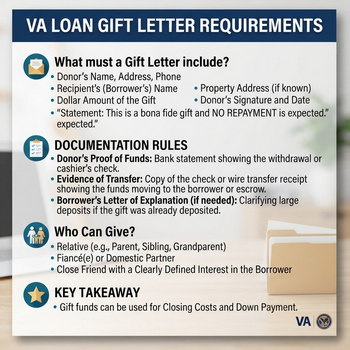 A VA loan gift letter is essential documentation that proves money provided for your home purchase is a genuine gift rather than a loan requiring repayment. When you receive gift funds from family members or close friends to help with your VA home purchase, lenders mandate proper gift letter documentation to verify the gift and protect both you and the lender. Without a properly executed gift letter signed by both donor and recipient, mortgage lenders cannot process your loan application. Understanding gift letter requirements, acceptable donor relationships, and documentation procedures ensures your VA loan approval proceeds smoothly without costly delays.
What Is a VA Loan Gift Letter?
A VA loan gift letter is official written documentation stating that money provided for a home purchase is a gift with no expectation of repayment. This letter serves as legal proof that distinguishes gift funds from borrowed money, which would affect your debt-to-income ratio and mortgage qualification. The gift letter declaration confirms the donor's relationship to the borrower and certifies that no repayment terms exist. Mortgage underwriters review gift letters during the approval process to verify fund sources and ensure compliance with VA lending guidelines. This documentation becomes a permanent part of your loan file.
Who Can Provide VA Gift Funds?
VA loan programs accept gift funds from specific donor categories. Acceptable donors include immediate family members such as parents, grandparents, siblings, and spouses. Extended family members including aunts, uncles, and cousins can often provide gifts if the relationship is documented. Close family friends with demonstrable personal relationships to the borrower may also qualify depending on lender policy.
Lenders strictly prohibit gifts from certain sources to prevent fraud and ensure compliance:
- Real estate agents or sellers cannot provide gifts, as they have financial interests in the transaction
- Mortgage lenders or brokers are prohibited from gifting funds
- Property developers cannot offset costs through gifts
- Cash gifts from unknown sources raise lender red flags and require extensive verification
- Employers may provide gifts only if the company has a formal assistance program
The gift letter must clearly document the donor's relationship to you. Lenders verify this relationship to prevent illegal fund laundering and ensure legitimate financial support.
Essential VA Gift Letter Components
Your VA gift letter must include specific information elements that satisfy lender requirements and prevent processing delays. A complete gift letter contains:
- Donor's full name, address, and phone number for lender contact and verification
- Relationship to the borrower (parent, sibling, grandparent, friend, etc.)
- Exact dollar amount of the gift being provided
- Property address where the funds will be used
- Expected closing date or timeframe for fund transfer
- Clear statement that no repayment is expected or required
- Signatures and dates from both donor and recipient
- Donor's statement confirming they have sufficient funds for the gift
Many lenders provide blank gift letter templates to ensure all required information is included. Using your lender's template reduces the risk of rejection or revision requests that delay closing.
VA Gift Letter Documentation Requirements
Beyond the gift letter itself, VA lenders require supporting documentation to verify funds and establish a clear paper trail from donor to borrower. Required documentation includes:
- Bank statements (2-3 months) showing the donor has sufficient funds available for the gift amount
- Wire transfer or check records documenting money movement from donor account to borrower account
- Deposit confirmation showing gift funds in the borrower's bank account
- Cashier's check receipts if the gift is provided by check
- ACH transfer documentation if funds are electronically transferred
- Explanation letters if funds come from unusual sources or require clarification
Lenders scrutinize this documentation carefully. Any gaps in the paper trail or unclear fund sources may trigger additional requests or delays. Complete and organized documentation accelerates the underwriting process.
Timing Requirements for VA Gift Funds
When you receive gift money for your VA closing costs matters significantly. Most VA lenders prefer gift funds deposited into your account at least 60 days before your mortgage application. This 60-day seasoning period establishes that the funds belong to you and provides clear documentation of their source.
If you receive gifts closer to your application date, expect additional scrutiny and documentation requests. Some lenders accept gifts received 30+ days before closing but require comprehensive bank statements and transfer records. Planning ahead and requesting gifts early in the homebuying process streamlines approval and prevents closing delays.
The entire down payment and gift amount must be fully transferred and deposited before your closing date. You cannot receive partial amounts during the mortgage process, as this complicates documentation and raises lender concerns about fund sources.
How to Write a VA Gift Letter: Step-by-Step
Writing a proper VA gift letter follows a straightforward format:
- Start with the date and the lender's name and address
- Address the letter to the mortgage company's underwriting department
- State your relationship to the borrower in the opening paragraph
- Specify the gift amount in both words and numerals (e.g., "Five Thousand Dollars ($5,000)")
- Declare no repayment requirement explicitly: "This is a gift and no repayment is expected or required"
- Include the property address where funds will be used
- Confirm sufficient funds: "I have sufficient funds available for this gift and this gift will not create a financial hardship"
- Sign and date the letter and have the borrower sign as well
- Include contact information for the lender to reach you if questions arise
Request your lender's template to ensure compliance with their specific requirements. Many lenders have standardized gift letter forms that speed processing.
VA Gift Funds vs. Other Loan Types
VA loans have more flexible gift fund rules compared to conventional and FHA programs:
- VA Loans: Accept gifts for closing costs and down payments from relatives and close friends. No minimum personal contribution required since VA loans typically have zero down payment.
- FHA Loans: Allow gifts for both down payments and closing costs from family and broader sources. FHA gift rules are similar to VA requirements but may accept gifts from non-relatives more readily.
- Conventional Loans: Restrict gifts to family members for down payments only. Borrowers typically must pay closing costs with personal funds. Investment properties prohibit gifts entirely.
- USDA Loans: Accept gifts from family, employers, and nonprofit organizations for down payments and closing costs. USDA gift rules align closely with VA requirements.
VA loans' flexibility with gift funds makes them attractive for borrowers who lack savings for closing costs. Understanding your loan type's specific rules ensures proper documentation.
Tax Implications of Gift Money for Home Purchase
Understanding tax consequences helps families plan gift strategies that minimize compliance burdens:
Annual Gift Tax Exclusions for 2026
The IRS allows individuals to gift money annually without triggering tax reporting. For 2026, each person can give up to $18,000 per recipient without filing paperwork. Married couples can combine their exclusions to provide $36,000 per recipient annually without reporting requirements. Amounts exceeding these limits require donors to file Form 709 (Gift Tax Return), though actual taxes rarely result due to high lifetime exemptions.
Lifetime Gift Tax Exemption
Gifts exceeding annual exclusions reduce the donor's lifetime exemption of $13.61 million (2025 limits). Most families will never exhaust this exemption, meaning they face no gift tax liability even for large transfers. Filing the gift tax return is a reporting requirement when gifts exceed annual limits but doesn't automatically create tax consequences.
Recipient Tax Obligations
As a gift recipient, you have no income tax liability on money received, regardless of amount. The IRS treats gifts as non-taxable transfers. Your gift funds become part of your total investment in the property but don't affect depreciation calculations or tax basis unless specific circumstances apply.
Documentation and Record-Keeping
Maintain detailed records of all gift transactions, including gift letters, bank statements, and transfer documentation. These records support any future tax audits or mortgage refinancing applications. Keep copies of all lender correspondence related to gift funds for your permanent records.
Common VA Gift Fund Mistakes to Avoid
Borrowers often make preventable mistakes that delay closing or jeopardize loan approval:
- Incomplete gift letters missing required information or signatures
- Delayed gift deposits received too close to closing without documentation
- Unclear donor relationships that lack documentation or appear suspicious
- Gifts from prohibited sources like real estate agents or sellers
- Missing bank statements showing donor has available funds
- Inconsistent documentation with conflicting amounts or dates
- Failure to disclose gifts to mortgage lenders or underwriters
- Treating gifts as loans by acknowledging repayment plans
Communicate openly with your lender about gift funds early in the process. Provide complete documentation proactively to avoid requests that slow closing.
Using the Debt-to-Income Ratio Calculator
Gift funds help reduce your mortgage payment by covering closing costs, which improves your financial profile. Use the debt-to-income ratio calculator to understand how different down payment amounts and gift scenarios affect your qualification and monthly payments.
Frequently Asked Questions About VA Gift Funds
Can I receive multiple gifts from different donors for my VA home purchase?
Yes. You can receive gifts from multiple family members or friends. Each donor must provide a separate gift letter documenting their contribution. Your lender requires individual letters for each gift source, complete with documentation showing each donor has sufficient funds. Multiple gifts must be properly tracked and documented to establish a clear paper trail.
What happens if I receive gift money but the deal falls through?
If your purchase doesn't close, you can return gift funds to the donor. Notify your lender immediately if your transaction cancels. Some lenders require written confirmation that gift funds were returned. Communicate with both your lender and gift donor to document the return of funds properly.
Can I use gift funds for a VA jumbo loan?
Yes. VA jumbo loans follow the same gift fund rules as standard VA loans. Gift letters and documentation requirements remain consistent regardless of loan amount. Lenders apply identical verification standards to jumbo loans.
Do I need to report gift funds on my mortgage application?
Absolutely. You must disclose all gift funds to your lender on your application and throughout the underwriting process. Failing to disclose gifts is loan fraud and can result in loan denial or foreclosure. Full transparency about gift sources protects you and ensures clean loan documentation.
What is the difference between a gift letter and a promissory note?
A gift letter certifies that money is a gift with no repayment expectation. A promissory note is a legal contract requiring repayment with interest. Lenders will not approve your loan if you acknowledge any repayment obligation. Gift letters must explicitly state no repayment is expected.
Can grandparents gift money for a VA home purchase?
Yes. Grandparents are acceptable gift sources for VA loans. They must provide a signed gift letter documenting their relationship to you, the gift amount, and confirmation that no repayment is expected. Bank statements showing available funds strengthen the documentation package.
Are there limits on gift amounts for VA loans?
No specific dollar limits apply to VA gift amounts. The gift can cover your entire down payment and closing costs. However, very large gifts may trigger additional scrutiny regarding source verification and donor ability to provide funds. Your lender may request comprehensive documentation for unusually large amounts.
Getting VA Loan Approval With Gift Funds
Success with gift funds requires organization and early communication. Inform your lender about gift plans before applying. Request their gift letter template and documentation checklist. Collect required paperwork from your donor in advance. Schedule gift transfers 60+ days before your mortgage application when possible. Keep all documentation organized and readily available for your underwriter.
When you use gift funds for your VA home purchase, proper documentation ensures VA loan approval proceeds efficiently. Work closely with your lender, maintain clear communication with your gift donor, and provide complete documentation proactively. These steps eliminate delays and help you close on your dream home smoothly. Contact a mortgage professional today to discuss how gift funds can help achieve your homeownership goals.
Connect With Us
Please share – it really helps