VA Loan Amortization Calculator & Schedule Guide for 2026
 Are
you a veteran or active duty service member considering a VA loan? Understanding your VA loan amortization schedule is essential to managing your mortgage effectively. An amortization schedule breaks down exactly how much of each monthly payment goes toward interest versus principal, and shows you the impact of extra payments on your loan timeline. Using a VA loan amortization calculator is one of the most powerful tools to visualize your long-term financial picture and identify opportunities to save thousands in interest costs.
Are
you a veteran or active duty service member considering a VA loan? Understanding your VA loan amortization schedule is essential to managing your mortgage effectively. An amortization schedule breaks down exactly how much of each monthly payment goes toward interest versus principal, and shows you the impact of extra payments on your loan timeline. Using a VA loan amortization calculator is one of the most powerful tools to visualize your long-term financial picture and identify opportunities to save thousands in interest costs.
What Is VA Loan Amortization?
Amortization refers to the process of paying down a mortgage loan over time through regular principal and interest payments. With a VA loan, your monthly payment amount remains fixed over the entire loan term - typically 30 years - and is calculated to pay off the entire loan amount plus interest by the loan's end date.
Here's what makes amortization unique: in the early years of your loan, the majority of each payment goes toward interest rather than principal. This is because interest is calculated on the remaining loan balance. As you pay down the principal over time, the interest portion shrinks and more of your payment goes toward reducing the principal balance.
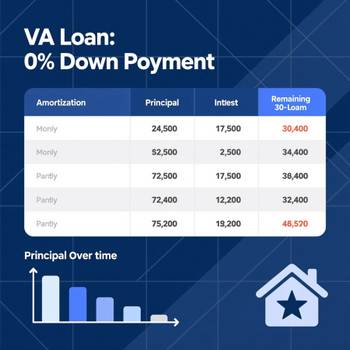
An amortization schedule is a detailed table that outlines exactly how each monthly payment is split between principal and interest. It shows how these amounts change over the years as you progressively pay off your loan. Most homeowners are surprised to learn that in year one of a 30-year mortgage, nearly 80–90% of their payment goes to interest.
How VA Loan Amortization Calculators Work
VA mortgage amortization calculators are designed to help you estimate your monthly payments and understand the breakdown of interest versus principal. To use one effectively, you'll input the following information:
- Loan amount: The total principal you're borrowing (after your down payment, if any)
- Interest rate: Your VA loan's annual percentage rate (APR)
- Loan term: The number of years to repay (usually 15, 20, or 30 years)
- Property taxes: Your estimated annual property tax costs
- Homeowners insurance: Your estimated annual insurance premium
- VA funding fee: If rolled into the loan (optional)
Once you input this data, the calculator generates a complete amortization schedule showing your monthly and annual principal, interest, taxes, and insurance breakdown. This schedule helps you determine affordability, see the true cost of your loan over time, and understand how much total interest you'll pay by the end of the loan term.
Extra Payments Feature: Accelerate Your Payoff
A particularly valuable feature of VA loan amortization calculators is the ability to estimate the impact of extra principal payments. You can enter any additional monthly amount you plan to pay above your standard payment, and the calculator will recalculate your entire amortization schedule accordingly.
This extra amount is applied directly to your principal balance before interest is calculated on the remaining balance. The result: the calculator will demonstrate how making extra payments reduces overall interest costs, shortens your loan term, and accelerates your path to owning your home free and clear.
To illustrate: an additional $100 monthly payment on a $400,000 loan can reduce your 30-year mortgage to approximately 25 years and save you over $80,000 in interest. Even small extra amounts compound dramatically over time.
Benefits of Making Extra Payments on Your VA Mortgage
There are significant advantages to making additional principal payments on your VA mortgage, beyond simply paying off your loan faster:
- Pay off your loan faster: Extra payments directly reduce your monthly principal balance, shortening the loan term by years.
- Reduce total interest paid: Since more money goes to principal each month, less is applied to interest over the life of the loan, potentially saving tens of thousands of dollars.
- Build home equity faster: Extra payments help you accumulate equity in your home more quickly than making minimum monthly payments.
- Lower total loan costs: Paying down the principal faster means paying significantly less in total interest over the loan term.
- Improve financial security: Building equity faster provides a stronger safety net and increases your home's net worth.
- Demonstrate sound financial management: Consistent extra payments reflect responsible money management, which can positively affect your credit profile.
When Extra Principal Payments Make the Most Sense
Consider making extra VA loan payments in these scenarios:
- Receiving a tax refund or annual bonus from your employer
- Paying biweekly (half your monthly payment every two weeks adds one full extra payment per year)
- Coming into a financial windfall from refinancing or selling a rental property
- Receiving funds from an inheritance or financial gift
- Paying off high-interest debt like credit cards or student loans, freeing up monthly cash flow
- A promotion or increase in household income
Even occasional lump-sum payments - whenever extra funds become available - can meaningfully accelerate your payoff timeline and reduce total interest costs.
Step-by-Step Strategies for Paying Extra Each Month
If you're committed to paying extra toward your VA loan principal every month, here are proven strategies to stay consistent:
- Set up automatic payments: Arrange to have a fixed extra amount automatically transferred from your checking account to your mortgage servicer each month. This removes the decision-making process and ensures consistency.
- Pay extra on payday: Align your additional payment with your paycheck schedule. This keeps extra payments from feeling like a financial strain since you're paying from fresh income.
- Use biweekly payments: Split your monthly payment in half and pay every two weeks. Over the course of a year, you'll make 26 biweekly payments (13 months' worth), effectively adding one extra payment per year without any additional effort.
- Round up your payment: Automatically round up your payment to the nearest $50 or $100. Over time, these small increases compound significantly.
- Prioritize your mortgage: Make your mortgage payment a priority each month before discretionary spending. This mindset keeps extra payments in focus.
- Track your progress: Use your amortization schedule to visualize how extra payments reduce your remaining balance and interest. Seeing the progress motivates continued effort.
Automating extra payments is the most effective strategy because it removes emotion and ensures you're building equity consistently.
When It Makes Sense to Stop Extra Mortgage Payments
While extra mortgage payments are generally beneficial, there are legitimate reasons to reduce or pause them:
- Job loss or reduced income: If you experience an employment change, maintaining your regular payment may take priority.
- Other financial goals: Saving for retirement, college education, or emergency funds may become more important than accelerating your mortgage payoff.
- High-interest debt: If you have credit card debt or other obligations with higher interest rates than your VA loan, paying those down first makes mathematical sense.
- Adequate equity: Once you've built sufficient home equity for your needs and risk tolerance, you may choose to redirect extra funds elsewhere.
- Low interest rate: If you have a very low VA loan rate (such as under 3%), investing extra funds in retirement accounts or market investments might yield better returns.
The key is to regularly reassess your financial situation and ensure that extra mortgage payments align with your overall financial goals and priorities.
Understanding Your Complete VA Loan Picture
Using a VA loan amortization calculator is one crucial part of planning your home purchase, but there's more to the process. You'll also want to understand other VA loan costs and requirements.
First, you must meet specific eligibility standards and obtain your Certificate of Eligibility. During the lending process, your lender will evaluate your credit score, debt-to-income ratio, and residual income during underwriting.
You should also budget for the VA funding fee, which can be estimated using a VA funding fee calculator. Many VA loans include the funding fee in the loan amount, so understanding this cost upfront is essential.
| Feature | Benefit |
|---|---|
| Down Payment | Many borrowers qualify for zero down payment, allowing you to purchase with no upfront cash. |
| Mortgage Insurance | VA loans do not require private mortgage insurance (PMI), saving you hundreds monthly. |
| Refinancing Options | Access to cash-out refinances and IRRRLs for future financial flexibility. |
| Property Requirements | Homes must meet minimum property standards, protecting your investment. |
| Assumability | VA loans can be assumed by qualified buyers, a significant advantage when selling. |
Frequently Asked Questions About VA Loan Amortization
What is VA loan amortization?
VA loan amortization refers to paying down a mortgage loan over time through regular principal and interest payments. With a VA loan, your monthly payment remains unchanged over the entire 30-year term. Each payment is calculated to pay off the entire loan amount, plus interest, by the end of the term. In the early years, most of your payment goes toward interest. As the loan balance decreases over time, more of the payment goes toward the principal.
How do VA loan amortization calculators work?
VA mortgage calculators allow you to estimate your monthly payments by inputting your loan amount, interest rate, loan term, and estimated property taxes and insurance. The calculator uses this data to estimate your monthly and annual principal, interest, taxes, and insurance, then generates an amortization schedule that shows how much your payment goes toward interest vs. principal each month over the loan term.
How much can I save with extra principal payments?
Extra principal payments directly reduce your loan balance before interest is calculated. For example, an additional $100 monthly builds over $30,000 in equity over 30 years. Even a single extra payment per year can cut your loan term by 4-5 years and save thousands in interest, depending on your loan amount and interest rate.
What strategies help me pay extra toward my VA loan each month?
Effective strategies include setting up automatic payments from your checking account, paying extra when you get paid, splitting your monthly payment in half and paying bi-weekly (which adds one extra payment per year), rounding up your payment to the nearest $50 or $100, and making your mortgage payment a priority each month before discretionary spending. Automating extra payments helps you pay consistently for the full benefit.
When should I stop making extra mortgage payments?
Most experts suggest continuing extra mortgage payments as long as you can afford them comfortably to maximize interest savings. However, it can make sense to stop or reduce extra payments if you lose income, other goals like saving for retirement take priority, funds are needed to pay off higher-interest debts, or you've built sufficient home equity. The key is to regularly re-evaluate your finances and ensure extra payments align with your overall financial goals.
Next Steps: Get Started with Your VA Loan
Ready to explore your VA loan options further? Start by using our free VA loan amortization calculator to model different scenarios and understand your potential monthly payment and long-term interest costs.
For more complex situations, explore guidelines for jumbo loans, manufactured homes, or past bankruptcies. You can also learn about the differences between VA and conventional loans.
To start your VA loan journey, learn how to apply for a VA loan and what you need to get a VA loan. The process leads to a clear-to-close and final closing.
For ongoing insights, visit our resource center for more articles and frequently asked questions about VA loans and home financing.
Connect With Us
Please share – it really helps