VA Loan Overview: The Complete Guide to the Earned Homebuying Benefit
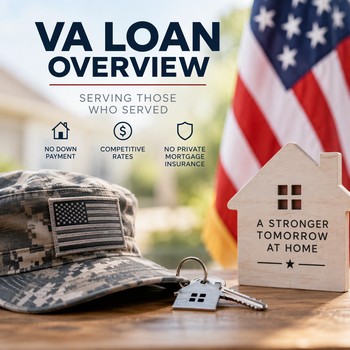 A VA loan overview starts with one key fact: the VA does not lend money—it guarantees a portion of your mortgage so private lenders can offer no down payment and no monthly mortgage insurance. Understanding how that guarantee works is the difference between using your earned benefit with confidence and leaving it on the table.
What Is a VA Loan and How Does It Work?
This VA loan overview would be incomplete without clarifying that the VA is not a lender. Instead, VA-backed loans are issued by private lenders such as banks, mortgage companies, and credit unions.
The VA's role is to guarantee a portion of the loan against loss. Because the government stands behind a portion of the mortgage, lenders are able to offer veterans significantly better terms, including the option for no down payment and competitive interest rates.
The program was originally created as part of the Servicemen's Readjustment Act of 1944 (often known as the GI Bill). It was designed as an alternative to a cash bonus for returning World War II veterans, recognizing that they often lacked the time to establish the credit history or career stability needed for a traditional mortgage.
Over the decades, the benefit has expanded to cover veterans of all eras, active-duty personnel, National Guard and Reserve members, and certain surviving spouses.
Key Financial Advantages
The VA loan stands out in the mortgage market due to several unique financial benefits that reduce the barrier to entry and the long-term cost of homeownership.
-
No Down Payment Required: In most cases, qualified buyers can purchase a home with zero down payment. The VA does not require a down payment as long as the purchase price does not exceed the appraised value and the lender approves the loan based on income and credit.
-
No Private Mortgage Insurance (PMI): Conventional loans typically require borrowers to pay monthly PMI if they put down less than 20%. VA loans never require monthly mortgage insurance, saving borrowers significant amounts over the life of the loan.
-
Limited Closing Costs: The VA restricts certain closing costs that lenders can charge veterans, helping to keep the upfront costs of buying a home lower.
-
Lifetime Benefit: The VA loan entitlement is not a one-time use benefit. Eligible veterans can use it multiple times, provided they have sufficient remaining entitlement.
Eligibility Requirements
To qualify for a VA loan, borrowers must meet specific service requirements and obtain a Certificate of Eligibility (COE). Generally, eligibility is based on the following service criteria:
-
Wartime Service: At least 90 consecutive days of active-duty service during a period of war.
-
Peacetime Service: At least 181 days of active-duty service during peacetime.
-
National Guard and Reserves: Six years of service, or 90 days of active duty under Title 32 orders (with at least 30 consecutive days).
-
Surviving Spouses: Unremarried spouses of service members who died in the line of duty or from a service-connected disability may also be eligible.
Beyond military service, borrowers must also meet the lender's financial requirements. While the VA does not set a minimum credit score, most lenders typically look for a score of around 620.
Lenders also evaluate debt-to-income ratios and residual income to ensure the borrower can comfortably afford the mortgage.
Understanding the VA Funding Fee
While the VA loan offers no monthly mortgage insurance, most borrowers are required to pay a one-time VA funding fee. This fee helps offset the cost of the program to taxpayers and is calculated as a percentage of the loan amount.
For first-time users with less than a 5% down payment, the fee is typically 2.15%. Subsequent users with less than 5% down pay 3.3%. Making a larger down payment can reduce this fee.
Crucially, many veterans are exempt from this fee. Borrowers who receive VA compensation for a service-connected disability, those who are eligible for compensation but receive retirement pay instead, and active-duty service members who have earned a Purple Heart are among those who do not have to pay the funding fee.
Additionally, as of 2026, the VA funding fee is tax-deductible for those who do pay it.
Loan Limits and Entitlement
A common misconception in any VA loan overview is that VA loans have a strict maximum loan amount. In reality, for veterans with full entitlement (those who have never used the benefit or have paid off a previous VA loan), there is no VA-imposed loan limit.
If a lender is willing to approve the loan and the property appraises for the value, a veteran can borrow as much as necessary without a down payment.
Loan limits only come into play for veterans with partial entitlement—typically those who have an existing VA loan and are looking to buy again without paying off the first one. In these cases, the VA's guaranty is limited based on the conforming loan limit for the county.
For 2026, these limits range from $832,750 in most areas to over $1.2 million in high-cost regions. If a veteran with partial entitlement wishes to buy a home above their remaining entitlement threshold, a down payment may be required.
Types of VA Loans
The VA program offers several loan products to meet different needs beyond just purchasing a home:
-
VA Purchase Loan: For buying or building a primary residence.
-
Interest Rate Reduction Refinance Loan (IRRRL): Often called a "streamline" refinance, this allows veterans with an existing VA loan to lower their interest rate or switch from an adjustable-rate to a fixed-rate mortgage with minimal paperwork and no appraisal.
-
VA Cash-Out Refinance: Allows homeowners to refinance their mortgage and take cash out of their home's equity.
-
Native American Direct Loan (NADL): A direct loan from the VA for eligible Native American veterans to purchase, build, or improve a home on federal trust land.
The Buying Process and Property Standards
The VA loan process involves a few unique steps. After obtaining a COE and choosing a lender, buyers must work with a real estate agent to find a home.
Once an offer is accepted, the VA requires a VA appraisal to ensure the property meets Minimum Property Requirements (MPRs) for safety, soundness, and sanitation. It is important to note that this appraisal is not a substitute for a professional home inspection, which the VA strongly recommends buyers obtain independently.
The sales contract should also include a "VA Escape Clause." This protects the buyer by allowing them to void the contract if the property appraises for less than the agreed-upon sales price, preventing them from overpaying or being forced to cover the difference out of pocket.
Conclusion
This VA loan overview confirms that the VA loan remains one of the most powerful tools available to the military community. With no down payment requirements, no monthly mortgage insurance, and competitive rates, it lowers the financial barriers to homeownership.
Whether you are a first-time buyer or a veteran looking to use your benefit again, understanding the nuances of eligibility, funding fees, and entitlement is the key to making the most of this earned benefit. As the VA continues to modernize the program—such as the recent tax deductibility of funding fees—it remains a cornerstone of financial stability for those who have served.
Frequently Asked Questions
Can I use my VA loan benefit more than once?
Yes, the VA loan is a lifetime benefit that can be reused multiple times. If you have paid off a previous VA loan and restored your full entitlement, you can use the benefit again without a down payment. If you still have an active VA loan, you may be able to use any remaining entitlement to purchase another home, though a down payment may be required depending on your entitlement balance and the county loan limit.
What credit score do I need for a VA loan?
The VA itself does not set a minimum credit score requirement. However, most individual lenders who offer VA loans will set their own minimum, which is typically around 620. Some lenders may be willing to work with lower scores if you have compensating factors such as a strong residual income or a larger down payment. It is important to ask each lender about their specific credit requirements before applying.
How do I get my Certificate of Eligibility (COE)?
Your lender can often obtain your COE directly from the VA on your behalf, sometimes in as little as one day. You can also apply for it yourself online through the VA's eBenefits portal, by mail using VA Form 26-1880, or through a VA regional office. The COE is the document that proves to your lender that you meet the service requirements for the VA loan benefit.
Can I buy a second home or investment property with a VA loan?
No, VA loans are strictly for primary residences. You must intend to occupy the home as your main residence within a reasonable timeframe after closing. This means you cannot use a VA loan to purchase a vacation home or a rental property that you do not plan to live in. However, you may be able to purchase a multi-unit property (up to four units) as long as you occupy one of the units as your primary residence.
What is the VA funding fee and do I have to pay it?
The VA funding fee is a one-time payment that helps offset the cost of the loan program for taxpayers. For most first-time users with zero down payment, the fee is 2.15% of the loan amount, and for subsequent uses it is 3.3%. However, many veterans are exempt from this fee entirely, including those receiving VA disability compensation and surviving spouses of veterans who died in service. The fee can also be financed into your loan rather than paid in cash at closing.
Can I get a VA loan while I am deployed or stationed overseas?
Yes, you can secure a VA loan while deployed. Modern technology allows you to complete most of the process remotely, including virtual home tours, online document submission, and electronic signing. You will need a stable internet connection and may need to coordinate with a trusted representative to handle any in-person requirements, such as the home inspection or closing, depending on your location.
Do I need a down payment for a VA loan?
In most cases, no down payment is required for qualified borrowers with full entitlement. However, a down payment may be required in certain situations, such as if the purchase price exceeds the home's appraised value, if you are using remaining entitlement from a previous VA loan, or if the lender has specific financial overlays. The VA does not mandate a down payment, but the lender ultimately decides based on your full financial profile.
Are there closing costs with a VA loan?
Yes, VA loans do have closing costs, just like any other mortgage. However, the VA limits certain closing costs that lenders can charge veterans, which can help keep your upfront expenses lower than with some other loan types. It is important to review your Loan Estimate carefully and compare offers from multiple VA-approved lenders to ensure you are getting competitive terms.
What types of refinancing are available with a VA loan?
The VA offers two main refinance options. The Interest Rate Reduction Refinance Loan (IRRRL), also known as a VA streamline refinance, allows you to lower your interest rate on an existing VA loan with minimal paperwork and typically no appraisal. The VA Cash-Out Refinance allows you to convert home equity into cash, which can be used for debt consolidation, home improvements, or other financial needs.
How long does it take to close on a VA loan?
VA loans close on a timeline that is competitive with conventional loans. In 2023, the average time to close a VA loan was 32 days, compared to 45 days for conventional loans. The timeline can vary based on the lender, the appraisal process, and how quickly you provide requested documentation. Having your COE and financial paperwork ready upfront can help speed up the process.
Connect With Us
Please share – it really helps